Sunday, 23 November 2014

Communications in design


Much of my career is based on communications, or as I like to understand it, on people. The social aspect of sustainability has always been my main area of interest, and it would seem that this is catching on.

Discussions on sustainability have so often been focused on material aspects (the integral design of a system or an object) and on politics (the regulatory system). These are without doubt important aspects but they are the extremes of a discussion pole: the technical precision of design and the strategic oversight of law. And yet, in the middle, there's a rather large entity which only ever seems to figure as an add-on: the users, the communities, the staff, the stakeholders. The people.

I contend on a daily basis with people who think this social aspect is "wishy-washy", a bid to seem reputable in the face of prying eyes or a PR stunt. And admittedly, communications can be all of the above. But in the world of sustainability, it is two-way communications which makes the success or failure of any project.

In his very interesting talk  on participatory design, Alejandro Aravena sums up the purpose of communications and engagement very neatly:

"Participatory design is not a hippie, romantic, let's-all-dream-together-about- the-future-of-the-city kind of thing. [...] It is actually not even [...] trying to find the right answer. It is mainly trying to identify with precision what is the right question. There is nothing worse than answering well the wrong question."

Indeed, it's no easy task either. Suddenly you're dealing less with logic than you are with emotion, personal desires and somewhat selfish outlooks. In Alejandro's example of a favela-like development, designers worked to understand from the early stages of planning (a key point in itself) what communities wanted, what they needed, and what could be worked to within resource constraints. The results have a beautiful simplicity to them, the kind that makes you think: 'oh yeah that makes sense, I can work with that.' And that is sustainability in a nutshell... logical.

At the end of the day, sustainability needs to be centered on the people who will ultimately be living it. Design needs to be practical to the end-user and policies or strategies need to be approachable. Otherwise success will only be short-lived.   

I would recommend watching his TED talk which you can find here. It's an inspiring look at some impressive and purpose-built designs. 

Admittedly... it's been a while.

My oh my it has been a while has it not. My fault, I stepped out for a coffee and then got lost in the world of "comms". Down the rabbit hole... as such. But Kermit perseveres, and so shall this blog, bringing with it more intrigue, innovation and general insight into the ever-growing realm of sustainability. Because it is ever-growing, and it still fills me with nerdy excitement which I feel I need to share with the anonymous world of the internet.

Proper blog post to follow shortly. In the meantime, here's a pretty picture.


Sunday, 15 September 2013

The Maya Experience

I just recently had the joy of visiting the Mexican Yucatan Peninsula, taking two weeks to travel around some well-known wonders of the world as well as some lesser-known hidden gems. Throughout my travels, I was surrounded by a rich history of Maya culture - a civilisation which has intrigued me since my early ventures into the world of sustainability.

As a student, I was always left wondering about the mystery of the collapse of the 'Classic Maya Civilisation'. The culture bloomed around the years of 200AD - 900AD, where the Mayans settled themselves as early masters of astronomy, mathematics and architecture. Did you know the Maya developed the concept of 'zero'... such a basic principle which underpins our own society. Even the Romans didn't think of that one!

Chichen Itza Pyramid of Kukulkan - an architectural marvel
In terms of architecture, the Maya built their temples with state of the art acoustics in mind. Not only with amplification of sound across unimaginable distances, but also with the ability to replicate the sound of the Quetzal Bird which was sacred to the Maya. Don't believe me, try clapping your hands at the foot of Chichen Itza's Pyramid of Kukulkan.

Palenque
But Chichen Itza was only the (rather touristy) cherry on top of the cake. The deeper into the jungle you go, the more marvels you see. The site of Palenque, my personal favourite, has barely even been excavated from within the jungle's hold, and yet you can still sense how far the Mayans had come by this point. A civilisation at it's peak.

But what comes up must come down? Or so that is what my previous studies of the Maya had taught me...
Palenque
Uxmal - Chaac rain god

Indeed the Maya then went through a heavy decline. The reason(s) for this have yet to be fully concluded but the population was growing at an alarming rate and resource use was increasing alongside. Here follows humanity's self-destructive nature... Deforestation is estimated to have played an important role in the civilisation's demise. As cities grew and expanded, competition and warfare ignited over resources. Jared Diamond in 'Collapse: How Societies Chose to Fail and Succeed' provides an interesting framework for collapse of great societies, including the Maya, noting the impacts of environmental damage, climate change (especially a lack of water), internal hostilities and political / cultural factors.

I could go into detail into the possible causes of this decline, however this would contradict one of the most important lessons I learnt. While I went to Mexico armed with this pre-meditated idea of the 'Mayan Collapse', I very soon realised that 'collapse' is not the right word... because collapse implies total failure. And yet the Maya culture and the Maya people are still very evidently present, with around 6 million living in Central America. There are around 30 Maya dialects still spoken, traditional native religions are still practiced, as well as various traditions (especially in weaving and textiles).

Had I not gone to Mexico, I would have written a lessons learnt story about a powerful civilisation destroyed by a lack of resilience, but I now feel this would be an injustice to this society. Obviously, there is still something to be understood from the decline of this prominent society, and this is something which I will touch on at a later date with examples of other great civilisations. For the moment though, I would prefer to focus on the fact that this culture, although significantly diminished, has survived the odds.

While it is easy to focus on the decline, I think there is a lot to be said for adaptability to changing political and cultural environments, whether from the Spanish Conquest or the current tourist trade.  And while we no longer live in a world where single civilisations grow independent of others (and where world cultures are more often than not integrated into one another) there's also a lot to learn from the innovation which this society was founded on.

Adaptability, resilience and innovation. I will touch on these subjects in relation to current civilisations at a later date. In the meantime... Dios bo'otik.

Palenque view from high on up - worth the climb!


Saturday, 1 June 2013

The ethereal nature of sustainability.

I was having an interesting discussion the other day on green buildings, when I was suddenly made witness to some jarring words. Uttered by a fellow sustainability enthusiast, I have to admit this statement snapped me out of my comfort zone:

"The word 'sustainability' doesn't actually mean anything."

I should provide some context; this was not meant in any way to deny sustainability any meaning, but was instead referring to the difficulty in pinning the concept down. Nonetheless, I couldn't help be disappointed by this choice of words.

Granted, sustainability IS difficult to grasp in any tangible form. Mostly, I'd argue, because it means so many different things to different people. If you consider sustainability by its three grounding elements (for those who haven't been keeping up, those are environment, society and economy), then that makes it rather all-encompassing! And what does a vision of sustainability look like? This will obviously change depending on whose behalf you are considering this question... your company, your country, your family, your home?

Safety, equilibrium, potential, innovation, logic, altruism, Masdar... these are just some of the words I associate with sustainability. You probably would take a different angle.

So why would sustainability not mean anything. Surely, it's the complete opposite, it does mean anything. It could even mean everything. The only thing that could limit your vision is your own perspective. (And note, I'm referring to the concept of sustainability here, not the approach to achieving it, which is significantly more constrained in reality). It all comes back to whether the glass is half full or half empty...

That is why I find those words upsetting. Vision precedes action. If sustainability doesn't mean anything, then what are we actually working towards. How can any positive concept be brought to life from a negative standpoint. I know I'm most likely being pedantic here, that person probably just used those words without thinking, and I don't want to assume I understand how that individual sees sustainability.  But it does bring to light an interesting question... how do people actually envision sustainability? And how do we make sure sustainability doesn't become something so ethereal that nobody believe they can strive to achieve it?

Thursday, 24 January 2013

Shake... and fold.

This will blow your mind away... You will watch all 4 minutes and 28 seconds of this and you will think: "Well yeah duh, I didn't need you to do a presentation to tell me that I can use less paper towels." BUT THEN... you will find yourself in the public restrooms of your choice the following day, and as you wash your hands it will dawn on you like a message from the gods.

Shake... and fold.


Note 1: I've tested it and 10 shakes also does the trick in case you are in a hurry or do not wish to appear like you are having a fit in front of friends or colleagues.

Note 2: I hope his next presentation covers the problem of removing paper towels from dodgy dispensers. Such a pain when you pull the sheet and it rips in half.

Note 3: If you're wondering whether I am absolutely serious about this or whether I am taking the piss, I'll have to get back to you as I am not entirely certain myself.

Saturday, 10 November 2012

The CIA. Licence to Adapt.

Did you know that in 2009 the Central Intelligence Agency (CIA) opened the Centre on Climate Change and National Security? It all seems pretty hush hush and for all I know it could be closed down considering the lack of information I can find about it on the internet. Nevertheless, it brings to mind a side of climate change which I had not previously considered... security.

Whether you believe that climate change is human induced or not, the fact that climate is changing should not be doubted. Rising sea levels, melting ice caps, droughts, flood - the impacts of climate change are wide-ranging, and can have a serious effect on people and places through resource depletion, migration, disease, conflicts and riots (among others). So why should climate change not be considered a threat to national security?

A report by the Defense Science Board (PDF) which urges the CIA to move forwards its climate change assessment operations states:

"Climate change is likely to have the greatest impact on security through its indirect effect on conflict and vulnerability. [...] Climate change is more likely to be an exacerbating factor for failure to meet basic human needs and for social conflict, rather than the root cause. Climate change is already intensifying environmental and resource problems that communities are facing."

The report refers particularly to the impact of climate change on developing countries. This article for McClatchy gives examples of flooding in Pakistan and the video refers to the Darfur conflict in Sudan as originating over resource and territory conflicts in the face of drought. How does climate change influence security for developed countries? Well the DSB report puts it in this ever-so-sensitive manner:

"The United States does have a vital interest in promoting stability in areas of strategic interest."

I guess we all know what they mean by 'strategic'. And although this hasn't been put very delicately, it is true that the globalised world we live in today means we are highly dependent on resources from elsewhere (oil, tech, food, etc. etc.).

So what role can the CIA and intelligence agencies worldwide play in helping nations adapt to the impacts of climate change? A lot, I would suggest. Acquiring climate data and modelling, for one. Prediction of potential risk areas will be key to adaptation. But also sharing this knowledge and working together with other nations to plan, implement and manage solutions. And then there is the issue of conflict and war over resources.

It's an interesting thought anyway. Not quite James Bond... but still a useful way to apply climate science.


Wednesday, 7 November 2012

Global Domination Through Sustainability

The thought came to me as I was going through some emails, what would global domination look like from a 'sustainable enthusiast's perspective? And what does one do when such a question pops into your head? You Google it of course... 

Top 3 search results:

1) An article in The Atlantic about Agenda 21 feeding right-wing conspiracy theories of robbing you of "your God-given right to your gun, your land, your water, your food, and your liberty."
(And the comment award goes to username Lefthandwitch with her poetic use of words: "Bad bad dirty bike riding poor people!")

2) A blog about playing with garbage... as you do.

3) A Wikipedia article on the New World Order conspiracy theory and the emergence of a "secretive power elite with a totalitarian agenda". (I still haven't identified where sustainability comes into this).

We have clearly established here that the sustainable movement is out to get you! Secretly, silently, creeping into your life and before you know it, you'll be growing your own tomatoes whilst wearing hemp trousers (cue every girl's scream in a horror movie). And here I was thinking I would actually get some helpful tips on world domination.

I'm quite amused by the thought of 'the sustainability conspiracy theory', where people meet in the dead of night, arranging community initiatives and considering ways of increasing your town's resilience, all in a wild attempt to gain control of the world - now and for future generations. The irony here is that sustainability is very much about not being dependent on others (whether for food, energy or otherwise), and therefore about having your own control. Still, I would happily take part in that revolution. Oh what a brave new world we will live in.

Sunday, 10 June 2012

Sunsets and Sustainability

It is 10 days till Rio +20 (the UN Conference on Sustainable Development), taking place in Rio de Janeiro, Brazil. Much excitement and controversy, I am sure. But check this out, they have this year done a picture amalgamation of people's views of sustainability. Quite literally. They have asked people to send pictures of what they think a sustainable lifestyle looks like.

It's a really interesting of way of seeing people's thoughts on the matter from all across the world. It's not very well set out or easy to look through all the pictures carefully, but just clicking on a few of them shows three major themes in the uploaded pictures.

There's lots of kids. Kids recycling. Kids planting trees. Kids volunteering or taking part in other sustainable activities / events. That make sense; sustainability / sustainable development is about a world where our children are guaranteed the same earthly privileges we have. It also shows kids taking the reigns: they are the future so it's generally a good thing if they're on board!

Animals of all shapes and sizes are also prevalent. Toucans, frogs, reptiles - all the exotic ones.That shows a strong focus on conservation... which links in well with the final theme, which seems to be most evident throughout the pictures: Nature. Islands, beaches, trees, rivers, lakes, and sunsets. Lots and lots of sunsets. All pretty much uninhabited other than perhaps a few huts or people jumping in the air in a very timely manner.

That tells me that people's 'views' on sustainability is focused on conservation, but perhaps more so on a lifestyle without urban settings. You get a sense of people wanting to 'get back to their natural roots'. Which I guess is an important part of sustainable development, but I can't help but feel there is a disappointing lack of pictures to do with sustainability within the 'non-conservation' area. There are a few pictures of solar panels, I even saw BedZed in there somewhere. Other than that, there's nothing very 21st century about it - which sort of defies the point of sustainable "development" doesn't it? Oh well, better to have sunsets than to have coal power stations!

Tell you what though, all those sunset pictures has made me want to go on holiday.

Monday, 4 June 2012

My belief.

I've started to wonder what it is that makes me an 'environmentalist'. Is it nature? Doubtful that it is nurture. A colleague recently asked me what 'made me green', and the question took me by surprise. My year studying for my Masters was spent with like-minded people - there were no questions as to why we would be studying such a subject, nobody would deny the importance of sustainability, of environmental thinking, or of trying to be green. This wasn't simply an understanding of the world around us, it was a motivation to act.

I now find myself in a situation where I am no longer surrounded by people with the same mentality. That is not at all to say that I am surrounded by climate sceptics or people of an 'anti-green' perspective, by any means. Rather, I get the feeling that people would be more likely to recycle because the facilities are available or because of a sense of obligation. It is a worthy cause, and quite rightly so. But what makes me green? Perhaps none of the above...

People's views are undoubtedly based on their experiences, on their understandings, and on their perceptions of the world around them. My multicultural upbringing, combined with my geographical background, has shaped the way I see humanity. I tend to look at things holistically, always trying to see the bigger picture. The world does not turn on its axis because of millions of separate processes, but because of the interconnections between those processes.

That's the environment; a series of cycles and balances between systems, all coming together to create one tiny rock within the vast emptiness of our universe. And I am a part of that process. Without it, I would not be. Volcanic eruptions, meteorite showers and god knows what other major events brought the chemical elements in the shape of our atmosphere, protecting us to this day from the dangers of outer space. It is those same chemical elements which give us water, which in turn sources life. Life bustles, creating smaller but no less important cycles. Societies develop, interconnect, and grow. And they do so by adapting to the elements of their localised environments, including weather patterns and geology. But societies will have just as much of an effect on the wider process as the process may have on society. Chemical elements will be returned to the atmosphere or oceanic currents may be altered. Not to plagiarise Walt Disney, but there's a certain circle to life!

If that's the environment, then being an environmentalist is about understanding those cycles, balances, processes or whatever you want to call them. And it is also about wanting to maintain a healthy balance between systems. Just like a dietician would tell you, balance is important - in your food groups and in socio-environmental systems.

So why am I green? Because I see something beautiful in the way our world works. Because it's so intricate that is is practically beyond comprehension. Because humans should not be arrogant enough to assume that they live external to the environment. Because being part of such a miraculous environment, millions of miles away from anything nearly as wonderful as our Earth makes us important. And because societal, political, and other human issues seem nearly insignificant compared to the immenseness of our world. (I said NEARLY insignificant - I'm not saying that they aren't important).

Yes The Lion King is my favourite Disney movie... how did you know? NAAAAAAAAAAAAAH SOWENYAAA MAMABEETSAMAMA.


Saturday, 14 April 2012

Communications: the mother of all sustainable weapons.

My oh my it has been a while! Being employed has taken a toll on my blogging recently but no fear, I'm just stocking up on inspiration and new matters to write about. Tonight, I thought I would write about a side to sustainability that is often overlooked, and yet so important (and which happens to be what my job is largely about... funny that!).

Communications. 

Communications should not only be at the heart of sustainability, but at the centre of any business - however big or small. I have said this before and I will say it many times more, being sustainable is the logical target for any organisation. Striving for it ensures healthy growth. But it will never be an easy process: social, economic and environmental considerations will always contradict each other. This is when communications comes in, like the missing puzzle pieces that connect the entire process/strategy/plan.

The point to clarify here is that communications is not about talking your way out of or into a particular situation. It is about explaining your point of view, listening to others, and ultimately pushing for dialogue (in other words - you should not find yourself being talked at, but rather you should find yourself in the middle of a conversation, even if it be a heated debate!) The deeper you go, the more likely you are to find points in common, and compromise quickly follows.

Communications is about allowing people to see the wider picture, instead of being stuck in their specialist bubbles or narrowed viewpoints. If it were to be personified, it would be that chap/lady who always seems so annoyingly sensible and who can diffuse any situation. Yep that's right, your mum basically! And we all know how powerful they can be at the best of times.

As a blogger and user of social media, I have always loved the concept of communications. This just gives a whole new dimension to it!

Till then... Stay Classy [insert where you live here].

Wednesday, 22 February 2012

The Five Stages of Job Acquisition

I recently wrote a post dealing with the psychological stages of job rejection. It was a bit dark. But in the name of balanced writing, I am now writing a post about the psychological stages of actually getting a job!

Stage 1: Getting the call/e-mail

This is the critical point. If you're reading an e-mail, you're skimming through for negative or positive words. If you're on a call, you're just hoping that the right words will come out of your mouth, whatever the decision. And then there it is. You've actually got it! Now it's about playing it cool. On the outside you're like: 'That's fantastic news. Thank you. You won't regret it. etc. etc.' On the inside you're like 'YYEEEEEEAAAAAAHHH!'.

Stage 2: The Stunned Silence

You've had the news. You've put down the phone or finally closed the e-mail after reading it twenty times. It's contemplation time. Pride bubbles up as you suddenly realise that the hard work has paid off. You've braved the numerous interviews, the dull applications and the manic preparation, and you've come out the other end with a win.

Stage 3: The Victory Dance

What... victory dances are cool. And who cares if you look lame, you've just got the job! Let your little feet express your happiness.

Stage 4: PANIC!

Easily summed up with: 'OH MY GOD! I've got a job. I need to be good at it! I need to find a place to live!! I need to go shopping for clothes!! PANIC BUTTON!!!

Stage 5: TBC

I'm not quite sure about this stage yet. I keep on moving from Stage 3 to 4 and then back again. I'm hoping something along the lines of ... serenity as you fit in and learn the ropes and generally become awesome at the job.

I will let you know!

Thursday, 16 February 2012

Human-Environment Interactions: Vulnerability, Adaptation and Resilience.

I wanted an excuse to try out Prezi, so I made this presentation... as you do!

Prezi is an online presentation tool. It follows the principle that you have one 'canvas' which you can zoom in and out of (as opposed to following slides). It's an interesting idea, and in fact it works well. It's simple, easy to use, and presentations can be made to look a lot more interesting. You can find out more at prezi.com.

The presentation is based on some of the concepts which were at the heart of my first dissertation. It deals with how socio-ecological systems (e.g. society) live within their environments, how they are vulnerable from various climatic, social, political and economic issues, and how these systems can improve their adaptive capacity. It's perhaps a bit dry but there may be some interesting concepts/ideas which you may want to look into further. It's not too long anyhow. Here it is:


The idea is that you can follow the presentation 'path' which I created, taking you through each point, by clicking on the little triangle icon. You can also zoom in or out at any point (use your cursor or the icons on the side) to look closer at something or to skip a few steps.

Notes on Prezi if you want to try it yourself:

  • Easy and relatively simple to get your head around.
  • The fact that it zooms in out and out (sometimes quite far) can actually give the audience a sense of vertigo - something to take into consideration when you're making a prezi. Basically, try not to swivel and swish too much.
  • You can present it online, or offline by downloading it. I have tried the latter, but from what I hear - the downloadable file is pretty big (and therefore difficult to e-mail to colleagues, etc.)
  • Easy to integrate Youtube videos or images.
  • Unless you upgrade (and pay) for a premium account, the prezis which you create will be made public (available to see for all in the Explore pages). So don't put any sensitive information in there. It is actually quite good to be able to see others' presentations (there are some interesting ones out there...)
On another note... I have just gone out of way (and actually got back into some old research and reading) to do a bloomin' presentation (for which I am not marked or paid for), all in the name of trying out some new programme. That's right. You can call me UBER-NERD!

Sexualising the Green Movement


I reckon they've got a good point there.

I also reckon they've hit on a good way to get people interested! 

Monday, 30 January 2012

Green IT... The Problem or the Solution?

ICT - Information and Communications Technology - plays an ever-increasingly important role in today's society, in the home and the business world alike. We can't live without it. Yet the IT sector is both environmentally damaging and a driver for green solutions. So is it a help or a hindrance?

Technological advancements in the IT sector have marked some hugely important steps in the way we interact with each other and how we get the latest info on the things we love/need. Where on earth would we be without smart phones these days, or what about Facebook and Google?!

ICT is vital to the way we live our lives. But a study by Gartner found that the IT sector accounts for around 2% of global carbon emissions... doesn't sound like much? That's equivalent to the aviation industry! It's a significant amount, and it's only going to grow as more data centres are needed to power this massive industry. Here's an interesting video which deals with the negative impact of the internet:


The funny thing about the IT industry is that, even though it might be a significant contributor of carbon emissions, it is also unavoidably a part of the green solution. Green IT is the upcoming trend, but IT in general can also help promote greener lifestyles, especially in businesses and organisations.

So what does green IT refer to? There are quite a few different aspects. Firstly, there have been significant improvements in the way data centres are managed, making them more energy and cost efficient. There are various approaches to this; from installing better cooling systems, to switching from older 'rack' servers to 'blade' servers (saving a significant amount of space in the centre). Alternatively, but closely linked to data centre efficiency, is the up-and-coming approach of virtualisation. I'm no techie, so I cannot give you the down and dirty explanation of this (Wikipedia has a helpful article), but in simple terms: it reduces the amount of hardware you have to use and power (by using virtual servers).

There have also been many important advances in IT which - although not necessarily green - have promoted more environmentally-friendly practices. I refer particularly to teleconferencing improvements, reducing the need for business travel and associated environmental impacts (not to mention business finances and productivity of workers). Developments like Cisco's Telepresence, which I find quite exciting, really make you feel that talking to people on the other side of the world as if they were in the same room as you is increasingly possible. Well, it's been possible for a while, but these kind of technological developments make it so much more easier to interact - would you rather an awkward call with a 3 second time lag (we've all been there...) or a room when you can walk and talk, and react not only to people's voices but movements and expressions, all without the 3 second time lag.

So where does that leave the IT sector? Is it a help or a hindrance to the environmental movement? Personally, I would say it's a help - or perhaps I should say, it will be of significant help in the future. At the moment, I don't believe enough focus is put on the benefits of green IT. And despite there being improvements in the efficiency of the sector, there are also huge developments occurring right now which practically make the current green improvements redundant. Take the rise of the 'Internet of Things' for example which will continue to grow and demand an even larger amount of energy to be powered.

Still, I can't help but feel that technology and IT will be a major player in the greening of things; it already is starting to be. Why? Because it can hit the most polluting areas (including its own innefficiencies). Large scale businesses, governments, social interaction, etc. At the heart of IT is improvement; so as long as the innovators continue to realise the importance of environmentally-friendly services (not only for the environment, but also for economic and social reasons), then I do reckon that IT could easily become the centre of a much greener society. Ever the optimist...

If you want any more info on Green IT, there's an interesting report by Lyonsdown, which has a number of interesting and easy to read articles on various green ICT issues.

Tuesday, 20 December 2011

I'm Dreaming of a... Green Christmas! (See what I did there?)

Only 4 days till Christmas! And in light of this merrily festive season, I thought I would write a post about the growing carbon footprint of this predominantly consumerised holiday. Driving with the masses to the shopping centre, buying presents and food produced god knows where, wrapping all your presents in heaps of paper, having the TV on all day watching the Queen's Speech (or Doctor Who in my case), driving to see your fam-

...

Hey what do you mean 'Bah Humbug'?! Oh alright... I'll keep things holly and jolly. But just in case you were interested in how Christmas carbon footprints have changed over the years, Best Foot Forward have made this Christmas Carol Infographic: The Carbon Footprint of Christmas Past, Christmas Present and Christmas Yet to Come.

Infographic Developed by Best Foot Forward. More information can be found on their website. 

But anyway, back to the merry side of Christmas! I just received a card with this picture on the front. I think, for me, this is as appropriate as it gets. And I'm proud that people feel the need to get me these cards. It shows that my green colours are shining out. It's also quite comical!


Having said that, Santa really is very un-green. I mean, my gosh, have you seen how much energy goes into his yearly traditions?! According to this very accurate study undertaken by Ethical Ocean, Santa releases up to 69.4 million metric tonnes of CO2 in ONE DAY! And approximately 97% of that is held within the life cycle of toys. This is simply unacceptable!

Graph taken from Ethical Ocean's infographic: Santa's Carbon Footprint.

From production to packaging and disposal, toys are by far the single most devastating contributors to climate change. So-called 'good' children around the world are leading to the untimely demise of this Earth. Not only that though, but the reindeer Santa uses to fly across the world are horrific methane producers. And, of course, there's Santa's polluting factory in the North Pole, which emits around 983,000 metric tonnes of CO2 into the atmosphere.

I think, having gained a better idea of Santa's inefficient and polluting methods, it is safe to say that - for the greener good - Christmas should just be cancelled. Or at the very least, he should get operations ISO 14001 certified.

Nooooooo don't worry kids this is all completely made up. Santa is nothing but goodness. Don't you know he uses magic to make all the toys in a special room where he lives; he has a few elf helpers, but that's got nothing to do with child labour. And his reindeer are way too awesome to ever let out any methane - except Dasher, I hear he suffers from IBS.

On a more serious note though... (I know, I know, bah humbug - but I wouldn't have this blog if I never put any green messages out), have a think about your impact this Christmas. Wrapping is obviously a big issue but it goes a lot further than that (and that's easy to recycle anyway). Christmas is so consumption-driven these days and that's when things get the least environmentally-friendly. And remember it's not about the presents... Haha, OK it's not ONLY about the presents, it's about sharing the good times, stuffing your face with (locally-produced and organic) food, and realising that you're half way out of the dark and wintery months.


MERRY CHRISTMAS EVERYONE!

Sunday, 18 December 2011

The Triangle: A Case of Logical, Effective and Inspiring Eco Housing.

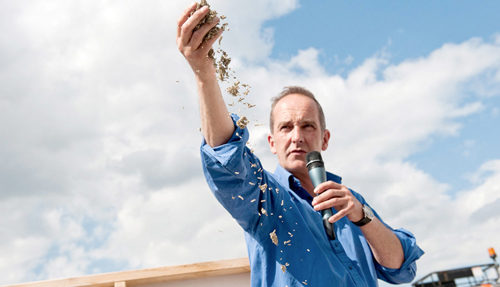
Anybody been watching 4oD's British Property Scandal series? I haven't watched all of them, but I've been keeping up with Kevin McCloud's Grand Design. It's all about HAB (Happiness - Architecture - Beauty) and their most recent development in Swindon: The Triangle.

I first came across this project about this time last year when Kevin McCloud came to University to present his views on eco-housing and architecture. From the point of view of a sustainability geek (as I am proud to announce that I am), HAB and The Triangle have proven to be an exciting and inspiring movement in the housing sector. So that's why it was great to be able to get a better sense of what this initiative stands for, and the troubles it has gone through to achieve it's aims.

I think one of the most exciting things about The Triangle and Kevin McCloud's objectives is that they actually aim to achieve all three elements of sustainability. I mean, there are a huge number of eco-housing projects growing around the country, but these are often only available to those with limitless funds. Likewise, 'eco-projects' tend to focus on the design of the house or the technologies used, but completely ignore the more social issues of communities and neighbourhoods. So it is refreshing to finally find a development which is not only environmentally-sound, but which also puts emphasis on community spirit while at the same time affordable.


A few brief facts about The Triangle:

Environmentally - the houses are build around simple 'eco' designs and technologies. High walls are used to provide a spacious atmosphere and huge windows make the rooms seem light and expansive. Hempcrete is used as an insulator and natural stack ventilation keeps the houses cool during the summer months. All in all, simple technologies provide a low carbon environment at minimal costs.

Economically - The Triangle comprises of a range of 2, 3, 4-bedroom houses and apartments, and these are available in the most affordable way possible. While some inhabitants are on Rent-to-Homebuy schemes, others were previously homeless or were on a housing lists. The idea is that, as good ol' McCloud puts it himself in the show, "even for a £160,000, you can live in a contemporary, beautifully-designed 3-bed eco home that feel bigger and lighter."

Socially - the houses are built around a communal green and residents share an area of land to grow vegetables. A neighbourhood agreement is set out and there are voluntary trips and workshops (for example, to learn how to grow lettuce!). And all of this is to help regain a sense of community, to make sure that kids can play safely outside on the green and to help people feel that they live not in a house, but in a neighbourhood. In fact, I think that's one of the most exciting things about this project. I don't even know my neighbour's last name! I speak to them occasionally, but it's always very brief and I would never feel that I could ask them for help in any situation.


Having watched the programme on 4oD, I would say that it is (overall) a success! That's not to say there weren't any problems (notably, a lack of storage space "for spare curtains" as one resident complained... who on earth keeps spare curtains?!), but these seem to be issues of design and a sign that things perhaps weren't too well thought out at the initial stages. Nonetheless, these are fixable. And indeed, they were fixed, leaving behind an innovative and friendly place to live. Not only that, but it is also a step away from what McCloud terms the 'bog standard'. Why do all houses in the UK look the same? (And I'm talking particularly about the more modern housing estates here). Bleak. Boring. Depressing. And at the end of the day, ridiculously energy intensive.

There is no doubt that change is needed in the housing sector, and The Triangle has proven that developers don't need to stick to the same dreary blue prints. So here's to Kevin McCloud for having shown that 'eco' is not simply for those who can afford to stick solar panels on their roofs. Eco-housing is inspiring. In it's most successful form, it is friendly and communal. It is the logical step forward.

HAB has got three more projects under way. If you want to find out more about them or about The Triangle, you can find out more at: http://www.haboakus.co.uk. Or do it the easy way, and watch Kevin's Grand Design on 4oD!

Ahhh Kevin McCloud... what a legend.

Monday, 5 December 2011

The Five Stages of Dealing with Job Rejection

Like the 5 stages of mourning... but with more anger.

Stage 1: Getting the e-mail.

You haven't read it yet, you just know that they have made their decision. Hope mixes with fear as you read the first line... but a quick glance over the e-mail and the sight of just one word brings you agony: sorry. You know 4 Weddings and A Funeral, the first scene where Hugh Grant is late in getting up for the wedding... yeah that's right Hugh: F*ck F*ckiddy F*ck F*ck.

Stage 2: Rage

Pretty much summed up with: 'WHYYYYYYYYYYY?!' You wasted my valuable time! You gave me hope and then you just drop me! Whyyyyyyyyy!

Stage 3: The 'Well-It's-Their-Bloody-Loss' phase.

It's like denial, but with a touch of self comfort.

Stage 4: Depression 

Also quite easily summed up with 'WHYYYYYYYYYYYYYYYYYY?!' but then followed by self-doubt. Suddenly, you see yourself having to live on the streets, playing the guitar to earn a bit of money, or worse... you will be 30 and STILL living with your parents. Oh GOD NO!!

Stage 5: Acceptance (with a bit of resentment)

Fine! I'll find something better... eventually... hopefully. And then I'll rock that job. And then... people will be coming to me and asking if I can work for them!

Like Dory from Finding Nemo... Just keep swimming. Just keep swimming! Just keep swimming!

Monday, 28 November 2011

COP-out (Attempt Number 17)

Sshhhhhh.... Can you hear that? Listen. Very Carefully.

That's the sound of politicians and delegates from over 200 countries failing. Failing to communicate. Failing to listen. Failing to see anything beyond their repertoire of 'sustainability is inherently bad for the economy'. Yep. That's right. It's COP-17!

I remember 2 years ago, when the Climate Change Conference was happening in Copenhagen. The news was just littered with stories about it. I had never really heard about these conferences before. My interest in the environment was only just budding and suddenly the media was chock-a-block full of (mostly) positive stories! What action plans will these countries come up with? Will China act? What will become of the Kyoto Protocol?? And then I quickly learnt that, despite the media buzz, none of these politicians were going to come to a decision.

One year later, and COP-16 in Cancun is spectacularly exemplified in this picture:

(Picture taken from BBC Online article)

So it's now it's Durban's turn to host this years conference. And to be truthfully honest, I reckon heads will stay in the sand. Oh such cynicism, I know! Don't get me wrong, my faith in the potential of sustainability remains unharmed, I just don't think politicians are going to be the ones to the lead the revolution. Whether it's environmental experts, businesses or consumers taking the lead, I'm not sure. But I can see politicians only having a follow-up role, after a lot of prodding and poking. I have this picture in my head... you know those movie sequences with old-school battles where rugged men just start charging, screaming and wielding heavy instruments? Yeah, I sort of picture that, except replace the heavy instruments with mini-windmills and home-grown cabbages. And the men are not really rugged, they're just angry every-day people, and battle strategies are drawn up by environmental experts. But it's not really a battle as such, more just a huge mass of people chasing after oblivious politicians in 4x4s.

My name is Maximum Sustimus Greenius, commander of the Armies of the Renewable, General of the IEMA Legions, loyal servant to the true emperor, *enter name of your sustainable idol here*. And I will have my local and organic soup, in this life or the next.

Urrrrr... yes well anyway you get the picture. Back to COP-17!

It's only Day 1 so there is still hope of some decisions being made. The biggest issue to deal with is the future of the Kyoto Protocol. I've never been a big fan of the Kyoto Protocol, because I've always had the sense that it just isn't working! The emission-reduction targets are barely satisfactory, and the most polluting countries haven't even ratified the Protocol (either out of choice *cough*US*cough*, or out of exemption *cough*CHINA*cough*). Having said that, I still think it is important to have a binding treaty for countries to keep to. Without the Kyoto Protocol, or perhaps a new treaty altogether, there just wouldn't be any political motivation whatsoever.

Kelly Rigg, in one of today's Guardian articles on the subject, sums it up pretty well:

"At the root of this failure is the perception that solving climate change is solely about sacrifice, about limiting rights to development."

And that's just it. A lot of people just picture sustainability as a cost, as a fashion, as a bourgeois fad, or as a hippy's religion. When really, sustainable development is an opportunity! I'm not saying it's free. Obviously, there are some initial investments - like companies who improve their heating systems, there are high upfront costs, but the rewards are quickly felt! Savings. Jobs. Markets. There is so much potential within sustainability, in so many different aspects; energy, food, housing, transport, business. Hell, even international cohesion would be a benefit... if these countries could only decide to make a decision.

Wednesday, 16 November 2011

CO2 is Totally (Recally) Green!

I just wanted to share this video. I love this. So much.


Firstly, there is something brilliantly clever about this. Portraying an extreme climate sceptic as a Sasha Baron Cohen character - that's mocking at its best! How the hell they managed to get an interview in the first place, let alone keep it going, is just beyond me. In a Guardian article, Craig Reucassel (the interview) explains:

"The interview was going for quite a while but when I hinted that he might be a comedian, he ignored it. as the interview went on I tried to make it more and more about that - but he just wasn't twigging."

Secondly, those eyes! Those horribly googly eyes! It took me a while to figure out what they reminded me of, but then it clicked... Total Recall! I was going to stick a picture here but a Google image search reminded of how disgusting that film is. In a very 90s special effects kind of way.

Thirdly, it ain't a YouTube video without the hundreds of comical, irritating and completely out-of-place comments. I've trawled through the despair to pick out my favourite:

"Stop listening to Al Gore, CO2 is Green. More CO2 in the air means more plant growth."

I mean, if you think about it... it makes sense! My gosh we've been looking at this climate malarkey in completely the wrong way! I was going to leave it at that. But then I found this little gem... a good way to end this post I feel. As Ali G used to say... Respect!

"Shut the *bleep* up with your pseudo intellectual *bleep* comments, this is YouTube, take that *bleep* elsewhere."

P.S. Apologies. This is arguably the worst post title I have ever come up with. 

Friday, 11 November 2011

Green... the Christian Dior of the supermarket.

So I'm not a big fan of Asda. I'm not quite sure why. Maybe it's because I associate it with my cheapest student days... and therefore that horrific Asda Smartprice Vodka (every student or past student who knows what I am talking about is now going 'Eeeeurgh'). Maybe it's because I don't like their shop layout; it just made my shopping experience that tiny bit more depressing. Or maybe, it's because of that ridiculously annoying advertising campaign... what the hell does slapping your ass have anything to do with 'saving you money every day'?! And don't tell me it's because you have change in your pocket because a) nobody keeps money in their back pocket and b) if they did, they wouldn't slap their butts to confirm it! But I digress...

Despite annoying adverts, it cannot be denied that Asda/Walmart is a hugely successful company, and it sure does some things right! Cheap prices for one. I mean, you can buy a bottle of Smartprice Vodka for only £3.50 - although you pay for it later as your esophagus is burnt by what is effectively paint stripper. But interestingly, Asda have recently put out a study entitled 'Green Is Normal'. And I have to say it is very interesting indeed!

They questioned over 3000 customers each month between January and August of 2011 about their values and attitudes towards sustainability and 'green consumption'. I'm not going to lie, I love me some value/behaviour studies - it was at the centre of my dissertation after all. Even better, I love value/behavioural studies with a happy conclusion. I won't outline the entire report, but five "new facts" came out of the study, all demonstrating that buying green is no longer considered strange or 'out there'. It is now the norm to consider where products come from, how they were produced, and what their impacts are. "The new weird is to do nothing".

Briefly, respondents stated that:

  • Green is normal; considering sustainable issues is 'intelligent' in terms of savings and energy efficiency
  • Consumers should play a more important role in discussing environmental issues
  • Green products should be easier to find; there needs to be clearer signposting to guide customers
  • Respondents claimed they planned/wanted to increase the amount of green products they purchase
  • Buying green shouldn't be more expensive; it isn't a 'fashion' which you should pay more for. 

Some very positive points here! ... But I wouldn't be a post-grad if I didn't look at it critically now would I?

It is honestly great to see that sustainability is penetrating the minds of the public in such a way. I would love to live in a world where environmentalism isn't only associated with Greenpeace members, but with the Average Joe who tries to make his office that tiny bit greener. However, if there is one thing I know about values and behaviour (and I know a fair bit), it's that values don't necessarily mean behaviour change. So Asda's study shows that people want to buy more 'green' - but that doesn't mean they will! And at the end of the day, it's action that counts.

Values are extremely important - they place the individual in the right state of mind to act in a specific way; but there are a huge number of barriers which could easily stop them. And this study has already highlighted two of them (albeit in a very positive way): clearer demonstration of green products, and - of course - price. It seems to be like this in every green-behaviour situation; I found exactly the same in my dissertation research for example... if people want to be green, they do as much as they can, but their full potential is hindered by organisational barriers. In the case of my research, it wasn't so much about price but about people with conflicting values and opinions.

So who's job is it to ensure that people can be greener if they so wish? Is it the consumers who have to push harder? Is it the supermarkets (or whatever organisation that may apply in this situation) who have to restructure their operations? Is it the environmental experts who have to come in and sort everything out (while also annoying all those who feel it is a waste of time)? Or maybe we just need to make sure that absolutely everyone feels that 'green is normal'... that would sort things out, it's unlikely to ever happen, but it would sure sort things out!

In my unimportant opinion, it's about getting all of the above to work together. And I reckon Asda have stumbled onto something good by doing this study and by asking the opinions of their customers. Communication is key after all.

It's a good report, and it's not too dense. If you're interested in reading it for yourself, click here.